Lilochek
A short story about the difficult beginning of a determined person’s life with a wonderful ending


Our journey with ABM began more than a year and a half ago. My second daughter, Lila, started having epileptic seizures in February 2024, which we only managed to recognize after 10 days. It turned out to be a rare epileptic syndrome—West syndrome. It is characterized by developmental regressions; as a result of West syndrome, cases of severe disability, cerebral palsy, various forms of autism spectrum disorder, and other neurological features are not uncommon.
We were able to quickly stop the spasms with hormones, but rehabilitation was needed. The child had gained a lot of weight and had "withdrawn into herself"; her right hand was barely used, and overall, my daughter was low in mobility. She could only roll from her back to her stomach and back, and slightly lift her torso while lying on her side. She participated little in family life and was not emotionally engaged.
I read a lot about rehabilitation and came across an article about ABM in French (we live in the suburbs of Paris). I really liked the philosophy of the method described in the article, its gentleness (which is important for children with epilepsy).
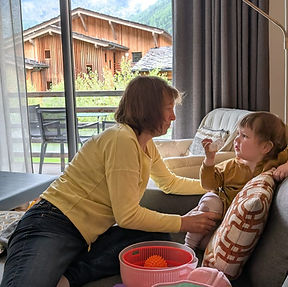
The story with ABM continued with the development of Lila's play skills and significant progress in walking and speech. Play became more varied — Lila began actively participating in the “peek-a-boo” game and showed interest in interaction. The fourth therapy session took place in May 2025 in the Alps, with the main focus on walking and speech. Although Lila could already walk with support, she could not get up from the floor on her own and could not walk without assistance. Despite seemingly favorable conditions for walking, something was holding her back.
In April, we underwent an intensive rehabilitation course at the A Pas de Chenille association in Brittany, which helped us understand the mechanics of getting up independently. However, Lila seemed to lack an internal sense of movement and confidence in her abilities. Therefore, we decided that the fourth ABM session would add the missing element. Sessions were held twice a day — in the morning and after the afternoon nap. By the second evening, Lila let go of my hand and took a few independent steps toward me. Since then, the distance gradually increased.
On the way back from Chamonix in a taxi, there was a window in the roof, and Lila, tilting her head back, said “Sky.”